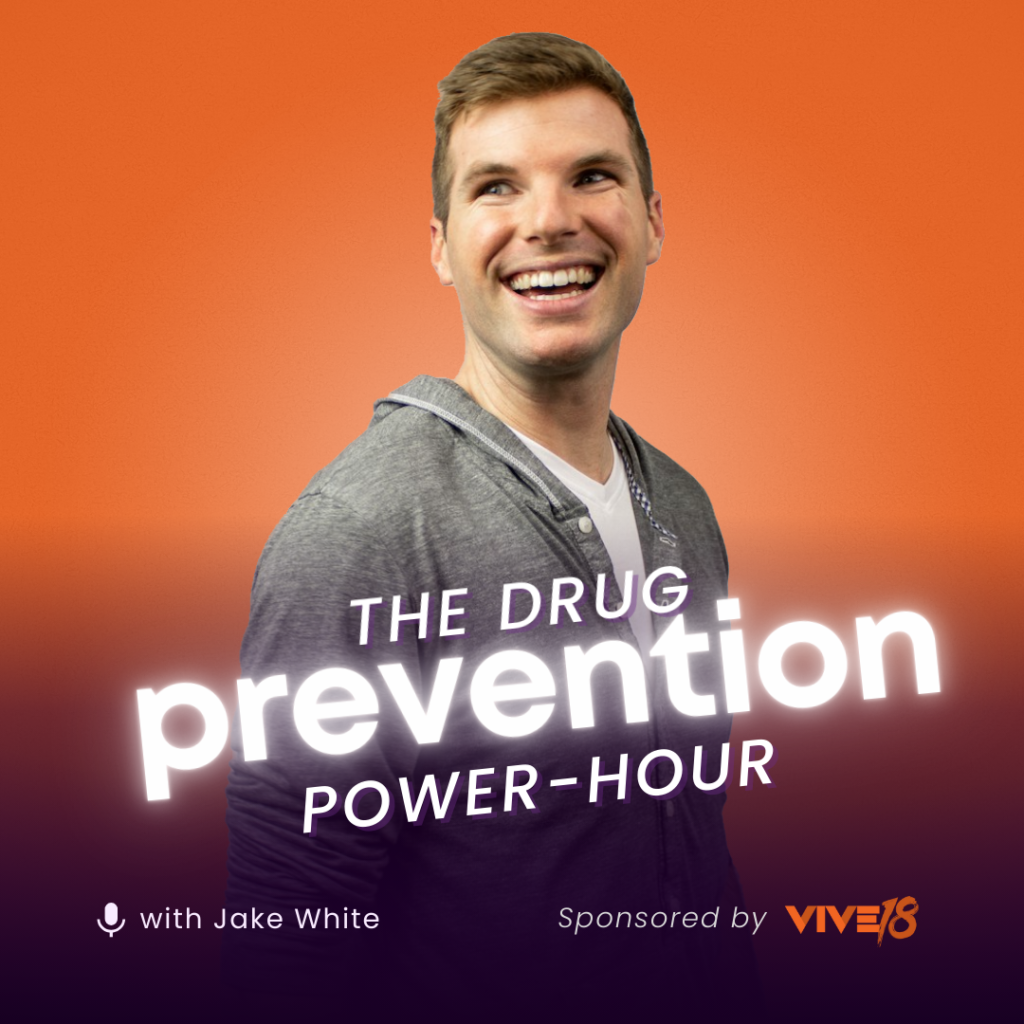
Jake’s Journey into Drug Prevention
The Drug Prevention Power Hour looks a little different today, cooler, and better than ever. I will be your host, Regan McDonald, and I would like to welcome my guest today, Jake White. How are you?
Hey, Reagan, well, you stole my job, so I’m okay.
Sorry, sorry. Someone had to do it. Someone had to. I was getting too full of myself, you know?
Yeah, I just had to bring you back down to earth for a second. And hey, today we get to hear more of your story as the one he’s normally asking the question. So that’s a little exciting, I guess.
Yeah, I’ll be excited to share, love talking about myself, so this will be super fun. Yeah, it doesn’t everyone? Yeah, I’m just trying to give you that outlet.
Yeah, you’re such a good friend. Really, I did this, I took your job for the betterment of you. You’re welcome. Well, in case our audience isn’t really familiar with the podcast, first time listening, I’d like to welcome you to the Drug Prevention Power Hour. We’re so happy to have you here. And this is Jake White, the normal host of the podcast, but I will be taking over on this student takeover edition. Jake, would you go ahead and just tell us how you got into the field, how you started Vive 18.
Just give us a little synopsis to get us going. Sure. It was in college. I had watched my uncle really struggle with an addiction and decided that I wasn’t going to drink or smoke in school. And it made me feel super weird. Like people would not invite me to stuff. They would act like there was something wrong with me just for making this healthy choice. And I had this idea that what if I threw an alcohol free party and just invite a bunch of people and try to have a ton of fun because that’s desperately what I wanted. Like I wanted the place to make friends and have fun. So I thought, all right, no one’s going to do it for me. I got to do it myself. And long story short, maybe you’ve seen my keynote before. You know, the first party was an epic failure, but it turns out people actually wanted this thing and it gave me the confidence to continue throwing drug free events. And it’s really turned into a nationwide movement.
Um, and I’m like blown away at all that’s happened over the last, well, like 12, 13 years.
That’s amazing. The impact that you’ve had in this past 12, 13 years, like even seeing you a couple of years ago to like getting to talk to you this year, mid-year, like even the change in that like couple year timeframe has been amazing. And it’s just been so great to see like the organization grow and just to hear your story has been so inspiring, at least to me. So thank you for everything. So, you you talk about how
Yeah, thank you, Reagan. I appreciate that. Yeah, of course you had this idea to start these alcohol drug free parties, right? And you said no one’s gonna do it for you. Have you like kind of always had that mentality? Like where does that stem from?
Leadership Lessons from Life Experiences
Dang, that’s a good question. No, that’s so good. I love it, Reagan, when someone asks me, because when you answer the same question hundreds of times a week, sometimes it sounds rehearsed. So I don’t know where it stems from, but I do remember when the lesson was really solidified in my brain. So my senior year of high school, I took a job at a golf course.
Sorry, this might be a little early to throw that at you.
And I was on the maintenance crew. So we were the one digging holes to fix the sprinklers, putting on gravel on the cart path, mowing the lawns, like all the stuff outside. And there was like all this trash on the golf course. I was the one who had to empty all of it into a golf cart, bring it back to the clubhouse. And there would be like 10 trash bins filled with trash and no one would bring it to like the big dumpster to be picked up. And I remember thinking to myself, we literally have to pick up the trash twice because no one wants to empty the trash into the dumpster. If someone, keyword here, if someone would just, when they’re done filling up the trash, just bring that one bag to the dumpster, we wouldn’t have to re-pick up the trash off the floor.
Put it in the bags and then bring it to the dumpster again and our boss would get mad and all this stuff. So this is honestly where I’m like, I’m going to be the guy who doesn’t care what anybody thinks. Like they can call me the what the brown nose or the somebody like, I don’t know, the person who’s lowest on the totem pole. I will be the one who serves everybody else by bringing the trash to the dumpster. And I think that lesson stuck with me, that if you’re willing to do the stuff that nobody wants to do, you’re going to be fun to work with and people will want to work with you, promote you, and give you opportunities.
Yeah, for sure. It’s that work ethic that really gets you places.
Yeah, agreed. you, I’m curious, because you’re on the basketball team. Is there a sense of doing something that nobody wants to do in sports? Does that exist?
Like it is weird going from being like the senior and having that leadership position to being like the freshmen at the bottom of the totem pole. But you know, no one wants to be early to practice. No one wants to stay after. No one wants to do the extra sprints, but you know, it’s those little things that are going to get you ahead and make you a better teammate. No one wants to cheer when they’re tired. Like no one wants to be uplifting all times of the day, but it’s those things that are gonna get you further in life. you know, I think sports give you a lot of life lessons. I think that working at a golf course gives you a lot of life lessons and just like finding those little things out of everyday situations that you can really apply to your entire life is how you kind of give meaning, don’t you think?
Yeah, that’s well said. I like that. Thank you. Maybe I’m pretty good at your job, actually. Dang it, I’m gonna go broke giving you raises. You might have shot yourself in the foot here.
It’s good problem to have. Okay, so I’m just thinking out loud here when you talk about how you’re gonna throw this drug-free party, alcohol-free, you’re gonna get this started. It takes a lot of leadership getting all these people involved. Obviously, I’ve heard your keynote a couple times. Like I know the story, but it takes a lot of like connection to bring all those people together, right? And so, Did you always kind of have those leadership qualities like through middle school, high school, or was that kind of something that came to you later?
The Importance of Inclusion and Connection
I was always an includer. If someone wasn’t invited to the birthday party, like I would want to bring them, or if they didn’t have a partner for gym class, I was going to be the one to say, hey, come be with me. So my heart has always been that way. But, and actually now that I think about it, my parents did this to me, like growing up, they would point out how this person might be feeling left out and how we should be the person to bring them in. And after a while, I think it just became a part of my character. But the leadership to be outgoing enough to invite people to something that’s like quote uncool or maybe seem risky or unpopular, that really happened in high school because I was moved from my comfortable high school that I had all my friends at to a new private school where no one knew me and everyone else knew each other. And I remember it was so hard. And Reagan, if this seems possible, imagine Jake, loud obnoxious Jake, not talking to people for like an entire year.
That’s hard. That was me. It was quiet, it was weird, but I was in a new environment. I watched all these loud obnoxious people make friends and they were just confident. So I was like, you know what? I’m just going to act confident and I’m going to have more friends. I’m not going to be afraid of being obnoxious or being noticed. And when I started doing that, it’s like, dang.
I’m starting to attract the right people into my life and I’m repelling the wrong people who don’t like me. This way of living is just so much easier. I’m going to live out loud from now on.
Yeah, I totally understand that. So, I like how you say live out loud. I love that actually, because it makes me think about like, when do you want to attract the people who are fun? Like, when do you want to attract like those like-minded individuals?
Right? Yes. Sometimes we get so scared of people seeing who we are because they might not like us. But honestly, that’s the gift. When someone recognizes, I don’t like you, then you don’t have to spend all this time and energy trying to make them like you. You’re just set free because you’re like, cool. We’re not a good match to be friends. That’s all right. I still think you’re awesome from afar, but we don’t have to try to bend over backwards when we’re really just not a good fit for friendship. Like that’s okay.
Yeah, it is okay to not be best friends with everybody. But because wouldn’t you rather have those best friends that really get you and are really like all in for you than like a bunch of people that don’t really understand you, you know?
And I think this meant something big I’ve had to learn like with the adjustment to college is I’d rather be like unapologetically myself and meet those people that are gonna support that and enjoy that and bring out that side of me than just be kind of in the shadows like, everyone kind of knows who I am, but not the real like who’s Reagan, you And I think that’s hard.
Yes. Yeah. It takes, it takes like a, an inner self-confidence, I think to say, I’m good with me. You don’t have to be.
Right, So, okay, just to bring everything back, you moved to this private school and you’re having a hard time like really putting yourself out there. Do you like notice the change once you start like just living for yourself? Like putting yourself out there.
Yeah. my gosh. Like high school version of me was like, this is so much better because now I have friends. I’m talking like it was night and day. The first year I probably had three or four people I would talk to. And honestly, they weren’t a good fit for friendship. They were very negative, but it was easy. Once they started being loud and being me, I started attracting those good friends. Like now I had friends we made a band together and we would play on the weekends. I wasn’t afraid to go try out for the basketball team, even though I was really bad, you know? All these things happen and it just makes life more fun. So I had more funs, I had more friends, and honestly, I just learned a lot more through life because I was taking more risks and everything got better, Reagan, everything. Yeah, yeah.
So I had fun. that’s amazing. Okay, when I want to cycle back, tell me more about this band. Like, you can’t just gloss over, we had a band for a little bit. Like, you gotta go into depth a little bit.
Oh my gosh, oh my gosh. I’m trying to think of how people can watch. So my friend in high school, his name was Nathan Stepanek, and he was like the songwriter. then he, so he wrote our music and then we would publish it on YouTube and we would play at coffee shops. And one time we got to play in the big city of Milwaukee.
So our band was called genre, like a genre of music. And just like any band of students, I think we changed our name like four times. So depending on what you look up, maybe if you look up on YouTube, Jake White drumming or band, maybe one of the old videos will come up, but there’s some pretty embarrassing stuff out there, but we had fun.
Building a Sober Community
I love that. Okay, so like what genre were you actually?
Yeah, it was a blast we were like, lot of his inspiration was red hot chili peppers and Weezer. So just stuff with really good guitar and bass and drums and then I forget what we were, we even did it into like first year of college. did battle of the bands and I forget, they wrote an article about us and they said like, we’re like a combination of red hot chili peppers and I don’t know, some other band, but I forget, but it’s like alternative rock, kind of. So if I take your job, you have a fallback, is what I’m hearing.
I need to add that to the rotation. Yeah. You don’t. Like I had a band, we did Battle of the Bands, my freshman year of college, like, ugh. Okay, see, this is why you have to give up your job a little bit so that I can ask the questions.
Yeah. Reagan, I wasn’t that good. I’m not going to make a living. You’re going to have to support me. You’re going to.
You could! They said you were a combination of red hot chili peppers.
Like, that’s kind of a compliment. Oh my gosh. No, Reagan, help me. You’re going to have to support me if I’m going to be a musician. I know this is not going to work. It’s not going to work. Just, yeah, slow your roll. All right.
I’m a college kid. Yeah, maybe not, maybe not.
Okay, okay, let’s bring it back. You got off track. You got us off track. You’re trying to sabotage me. Okay, I’m gonna reel it back in with probably something that might require a little more thinking than your band story. So if you had to look back and think about when you first start throwing these drug and alcohol free parties.
Yeah, yeah, my bad, my bad. That’s right. Was there anyone around you like were you doing it by yourself? I guess or did you have like a group of people that helped you out? Like what did that look like?
The Challenge of Leadership Transition
Yeah, one of my really good friends in school, his name was Steven, and he helped me right away. And so I was like the party side and he was the business side. So I was thinking through all the experiences that we were going to have and the themes and the games and all that stuff. And then he made us a sponsorship packet that highlighted the success that we had and the marketing list that we were building. And we together would go out to local businesses and ask for sponsorship and stuff. So that, yeah, that was super fun. He was so, so helpful. And then after probably like a year of working together, he’s like, Jake, we’re seniors. I got to start looking for my business internship. And by this time I was thinking like, well, I think this is going to be my job. So I’m going to stick with this. And then after that, it was kind of just me, but I made it a point to always be coaching someone. So like an underclassman that would I would bring with me to teach the ropes so that when I graduated, it wouldn’t end. And I think I would put that out for any student leaders out there. Like if you are really good at what you’re doing, you need to bring someone to like shadow you and then take over your job. Kind of like you’re doing for me, Reagan. Like this is so healthy for an organization to have that person that’s gonna become the next you. That’s kind of what I did near the end.
So like, as you were starting to train this new person up, not necessarily talk about me, like you give enough job, whatever. As you were starting to train this underclassmen when you were in college, is any part of that like hard, like to give it up to someone else?
Yeah, your ego hurts so bad. Also, because someone doesn’t do it exactly like you, like you want to take back the reins, but you just have to say, no, it’s okay that they don’t do it like me. They’re going to bring their own flavor. They might even mess up. Like they might take what you did and change the name completely or have an event that totally flops and realize that that’s okay. So the tough part was going from doing everything just like to say to then letting them do it and being the coach to say, Hey, what did you love about that? What didn’t work? Can I give you some guidance on why that might not have worked? you know, take it or leave it. This is your club, but here’s what I noticed. And that was helpful to get like, but the ego is so hard for me because I think that I’m amazing and everything I do is so cool. When in reality it’s like, dude, no one is obsessed as obsessed with you as you are Jake, like you’re living inside your head. So just get out of it. Let someone take the reins and you know, it was cool too. Like I had a student take over, after me and what’s cool is he’s written his own book. Now his name is Chris Sherrill and he would, taught him how to throw sober parties. He brought it all throughout the Greek life system at our school and just, he had, he had more students than I ever had. It was great at it.
Yeah then we taught this really, really shy kid who we thought like, man, there’s no way he could do this. He’s too shy, but he was really successful at it. And it really just broke that mold and really taught me, all right, Jake, you’re not that special. It doesn’t have to be you it really opened up that coaching ability for me.
Identifying Future Leaders
Yeah, I can definitely like relate to giving up the reins is hard and to any like student leaders listening like I just left my high school’s coalition and After leading that for as long as I did like it was hard, know like to give up It’s almost like your baby like you pour a lot of time into a project or a club and then all of a sudden like it’s someone else’s but I think it’s important to make sure that like the club’s not just gonna die. Like this project isn’t going to go away when you leave. Like you have to let it grow. And I love what you said about like giving it to the shy person. You know, like there were, I’m a firm believer that everyone’s got a gift. You know, not everyone was meant to stand up on a stage and give their story like you do. Okay. It’s a great gift of yours. It’s a great gift, but not everyone’s meant to do that. You know, there’s, Stevens out in the world who are meant to do the business side of things. They’re the marketers They’re just the people who make connections and so I would like to ask a little bit more about like how do you Identify like the person that you want to hand off your project how do you identify them? I think most of it comes down to their their heart their interest it’s it’s It’s kind of like when you start something new or you get into a new relationship You don’t want to like jump into a new relationship with too much expectation because you scare people away But if you invite someone in to maybe help with one role or one job and they do they’re so excited and they’re thankful.
And you’re like, this was great. You know, what else can I do? And you give them a little more responsibility and you develop that relationship. That can really, really help. And that’s where you’re, you’re literally building talent. Like when you said, take the shy student still has the gifts and sometimes they, they might have a gift that’s unseen yet because it hasn’t been tested. And so when you’re thinking about who is in your organization or who you want to teach.
Sometimes it’s the slow people who get involved in the organizations or sometimes it’s like you identify their strengths in another organization or another initiative and you say, hey, we need your strengths over here. Are you interested in this mission? And if it lights them up and they’re like, my gosh, I’m really passionate about that. Then you’re like, great, let’s get you plugged in. And it’s a lot more, it’s like a faster transition where they can just plug right in and start creating really cool stuff.
Yeah. Okay. Okay. So in like creating this really cool stuff, in any prevention work, in any leadership work that we do, like there’s bound to be pitfalls, right? There’s bound to be times when like we do fail. I mean, as awesome as I am, like I did have a couple of events that didn’t go too well for me, you know and so, well, as you’re like building this new leader up and trying to hand off the reins when they stumble, What would be your advice as like how to bring back their confidence or like help them keep going when it’s not necessarily easy?
Encouragement in Leadership
All right, when someone fails and you’re their coach, the first thing to realize is that every moment is not a coaching moment. There’s some things that are called encouragement moments. And so after they fail, the last thing they need is for you to identify the failure and then stamp it on them. Oftentimes they need some encouragement to say, along your leadership process, here’s where the failure lands. And you like, we need to celebrate that failure and say, Hey, here’s what you did amazing. Here’s why you’re super brave. Here’s why this failure is not the end. then having regular coaching moments. And this is something I’m trying to get better at with a busy schedule. There needs to be one-on-ones with your team so that you can encourage them in the moment. But then when you have your regular one-on-one on Monday, then you can bring up the coaching moments and ask them in regular 1-on-1.
Hey, what would you change about what happened? Let them identify that. You can congratulate them because they probably said 75 % of the things that you wanted to tell them, they discovered it themselves and that’s going to be really powerful. Then the 25 % that they missed, you can say, hey, I identified a couple things that I saw too that could be improved on next time. Do you mind if I share? Awesome. Here’s the three things.
That I think is the best way to do it. Okay, and in doing so, when you are like bringing someone up and there’s a lot of, you talk about how you need to encourage at the same time. I think we forget that a lot, you know? Like there’s all these things that are going wrong, but simultaneously, the majority of things are going right, right? Like usually we’re doing a lot of things well, but our eyes are immediately drawn to like what went wrong, right? So.
Right? When you are having to like bring up these criticisms and really like have those coaching moments, how important do you think it is in this scenario and just in like prevention in general, how important do you think that like relationships and connection are? Like should we even worry about like making friends or like building those relationships with other people or is this more of like a no one else is gonna do it? Like I can do it all on my own type of thing.
If you want to go far, go together. If you want to go fast, go alone. And so if you just kind of have to realize what is your end game. If you’re the person who’s supposed to launch something. Maybe you don’t need the relationships yet because you’re going really fast and you need to try a bunch of things and fail that’s the only time when I would say like relationships wouldn’t be important because you don’t even know what you’re doing yet. Once you figure out what you’re doing and you have a mission that’s worth spreading, you immediately need to prioritize relationships. And by the way, this is just my opinion right now. I could be totally wrong because I’m still learning so much. There’s a book, I think it’s called Who Not What? But it talks about this idea opposite of what I just said. So there’s my perspective on how I built this. Then there’s the opposite perspective, which is actually you should not even do anything until you have the right people on the bus because the right people are going to identify that problem better than you can. So I don’t even know if I answered your question or if I know the answer to it, but those are two thoughts.
I guess just like how important are those relationships in your life? Like even outside of prevention, like talk about how you’re loud and obnoxious. Like I wouldn’t say those words, those are your words, okay? I would not put it that way, but you’re very outgoing, right? And so like, would you say that relationships are a big part of your life that like they drive you or are you more like kept to yourself?
The Importance of Relationships
Yeah, for me, relationships are everything because I think my mission on this earth is to make disciples of all nations. My mission is to spread the gospel. And you can’t do that alone and you can’t do that if you care about people. So, Vive 18 is just like this vehicle. And I’m also an extrovert, like a very, very big extrovert.
I need these conversations and relationships or I’m not going to get my cup filled to go spread and impact the world yeah, honestly, now that I’m saying this out loud, I am so blessed that God gave me this job because the job fills me up and the job helps me pour it out. It’s pretty incredible, but relationships are everything.
Mm-hmm. Yeah, I would totally agree. so, you know, relationships are everything. Has there been, like, besides, like, Steven, of course, your original partner, if you go back to, like, your childhood or how you got through, high school, who, like, comes to mind as, a key relationship that helped you out? Or that, like, inspired you growing up?
Yeah, honestly, my dad was one of the biggest inspirations because we had so much car time growing up. He would tell me things that would stick with me, ⁓ which like, I think I talk about him a couple of times, or at least once with the guitar hero story in my speech. The lesson of 15 minutes a day. He also knew I was really motivated financially.
So he would teach me about things like compound interest and how the things you do now are going to compound for the rest of your life. And he taught me through money. And so when I went through high school, I think of the struggles that I had of like, right, well, I don’t feel good about my body. Like I’m insecure about being skinny or I don’t feel like I fit in with other people or I don’t want to be made fun of. I want to be like everybody else.
There was these common themes, but because I had developed this long-term mindset with my dad’s advice and the time that he spent with me, I feel like I didn’t cave under those things. And instead I could really prioritize what mattered in life. And he was so good at being that encouragement and that coach. know, like when I fell, it was like, Hey Jake, here’s the process of being successful. Yeah, you failed.
That’s all right. And then, also giving me the tough love of like, you probably shouldn’t do this thing again, because that’s going to give you that result again, you know? So I definitely would answer that with my dad. Shout out Pat White.
Shout out Pat White, that is beautiful. We’re so glad that he had that impact on you and that you’ve been able to use so many of those skills and what you do. And it’s just been able to impact so many people. And so for me and from anyone listening, I would just like to say thank you. Because it has been just, it’s so remarkable everything that you’ve done. And with that, I would really like to thank you for being on my show.
I would ask you for a social media handle, but this kind of goes on your social media, so whatever. But before we end the episode, I would just like to thank anybody listening for being here today and for doing your life-saving work. And to all the student leaders out there, just keep doing what you’re doing. Thank you for everything you do and for getting other people involved and just keep working hard and keep doing your mission because it will pay off in the end. if you enjoyed this episode, please share it with a friend or someone who you think would benefit from hearing it. And we’ll see you next week for another episode of the Drug Prevention Power Hour. Thank you for listening.